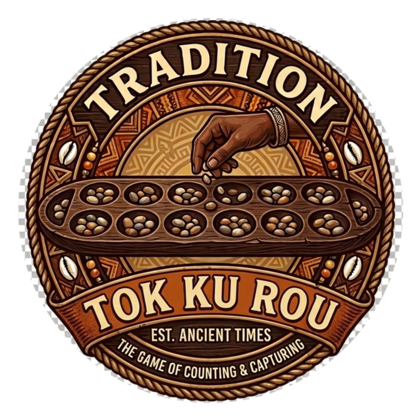
Tok Ku Rou: Centuries of South Sudanese Tradition
Discover the heritage behind Tok Ku Rou — the traditional four-row mancala of South Sudan, played by many communities across South Sudan — and learn the tactical rules that make every match a real contest of foresight.
🇸🇸 The Heart of South Sudanese Board Games
Tok Ku Rou — literally “one and two” in Dinka — is a traditional board game woven into the social fabric of South Sudan communities
Traditionally played in community gatherings under trees, elders and youth alike gather around boards carved from local hardwoods, or holes dug directly into dry clay soil, using stones, wild seeds, or polished pebbles to play.
A Game of Math and Foresight
Unlike games of pure chance, Tok Ku Rou is a strict test of mathematical precision, spatial memory, and long-term planning. It has long served as an informal educational tool, teaching young players quick arithmetic and strategic thinking.
Game Rules & How to Play
1. The Board & Setup
- The board has 4 rows of 12 holes each — 2 rows per player.
- Your back row is furthest from the middle; your front row sits directly across from your opponent's.
- Every hole starts with 2 pebbles.
2. Making a Move
- Choose any hole on your own side that has at least two pebbles in it.
- Pick up all its pebbles and sow them one by one into the following holes, moving along your own two rows — pebbles never leave your side during a normal sow.
- If your very last pebble lands in an empty hole, it stays there (a “sleep”) and your turn ends.
3. Capturing
- If your last pebble is about to land in an occupied hole on your front row, and both of your opponent's holes directly across that column still have pebbles, you capture ("eat") all of them.
- Captured pebbles join the ones in your hand, and your sow continues — a single move can chain several captures in a row.
4. Winning
The game ends the moment a player has no movable hole on their turn. A hole needs more than one pebble to sow from, so once every hole on your side holds a single pebble or none, there is no move left to make. Whoever holds more pebbles on the board at that point wins — an equal split is a tie.
Fun fact
A loss is not counted in pebbles alone. Traditionally, the player who loses a game of Tok Ku Rou is said to have had a bell put on their neck by their opponent.